
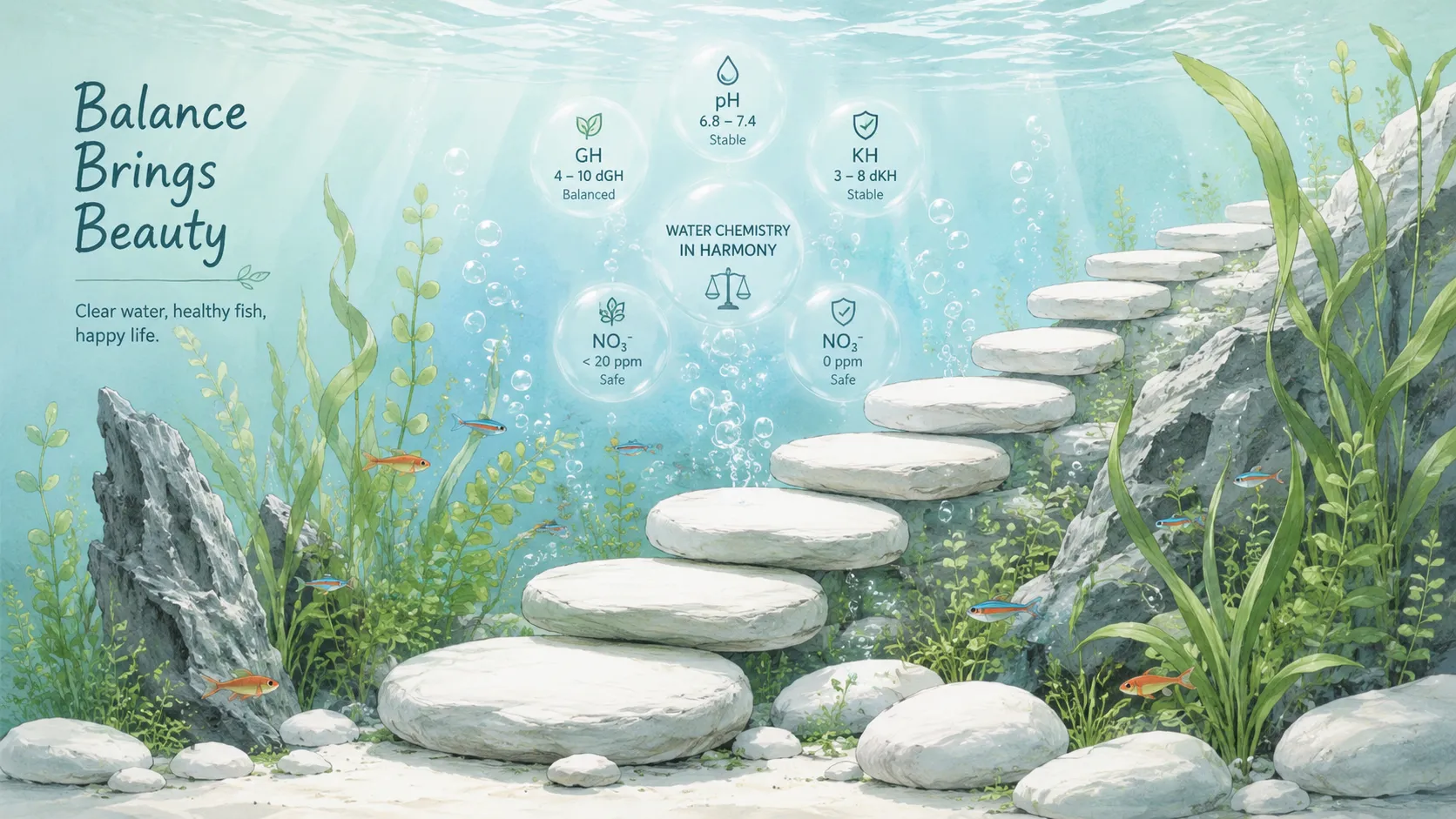
Aquarium owners often obsess over pH, ammonia, or nitrate levels while completely overlooking one of the most important water parameters in fishkeeping: carbonate hardness, commonly called KH. The funny thing is that many pH problems are actually KH problems wearing a disguise. If your aquarium water suddenly swings from stable to chaotic, there’s a good chance your carbonate levels are dangerously low. Fish don’t just need clean water; they need stable water. Stability is what separates a thriving aquarium from a stressful environment where fish constantly struggle to adapt.
KH acts like the shock absorber of your aquarium. It protects the water against sudden acidity changes and keeps the pH from crashing overnight. According to aquarium chemistry sources, KH measures bicarbonate and carbonate ions that neutralize acids naturally produced inside the tank. Without enough buffering capacity, biological waste, decaying food, and even normal respiration slowly eat away at water stability until fish begin showing stress symptoms.
Many aquarists discover low KH the hard way. Maybe the fish suddenly stop eating. Maybe shrimp start dying mysteriously. Maybe the pH seems impossible to stabilize no matter how many products are added. It feels like trying to patch a leaking boat with duct tape. Unless the carbonate reserve is restored, the water chemistry continues drifting toward instability.
This guide explains exactly how to raise carbonate in a fish tank safely, why carbonate hardness matters, the best natural and commercial methods for increasing KH, and how to maintain stable aquarium conditions long term without shocking fish or causing dangerous pH swings.
Understanding Carbonate Hardness in Aquariums
What KH Actually Means
Carbonate hardness, abbreviated as KH, measures the concentration of bicarbonates and carbonates dissolved in aquarium water. These minerals act as a natural buffering system that resists changes in acidity. In practical terms, KH determines how well your aquarium can handle acid buildup before the pH begins dropping dangerously low. Aquarium chemistry references describe KH as the water’s “buffering capacity” because it absorbs acidic compounds before they destabilize the environment.
Think of KH like the suspension system in a car. When the road becomes rough, the suspension absorbs the impact so passengers don’t feel every bump. In the same way, carbonate hardness absorbs the acidic stress constantly produced inside a fish tank. Fish waste, decomposing organic matter, nitrification, and excess CO2 all generate acids over time. Without KH, these acids would slam directly into the pH level and create dangerous fluctuations.
Many beginners confuse KH with GH, or general hardness. They are related but completely different measurements. GH refers mainly to dissolved calcium and magnesium minerals, while KH specifically measures carbonate and bicarbonate ions. A tank can have high GH and low KH or the opposite depending on the local water source.
Aquarium KH is usually measured in degrees of carbonate hardness, called dKH. One dKH equals approximately 17.9 ppm of calcium carbonate. Most freshwater community aquariums operate safely between 4–8 dKH, though some soft-water species prefer much lower levels.
The Relationship Between KH and pH
Many aquarists assume KH and pH are the same thing, but they work more like dance partners than twins. KH controls how resistant the pH is to change. A higher KH creates stronger buffering, which means the pH becomes more stable and harder to alter. Low KH leaves the pH exposed and vulnerable to dramatic swings.
Imagine trying to balance a pencil vertically on your fingertip. That’s low KH. Tiny environmental changes immediately knock the pH around. Now imagine balancing a bowling ball instead. That’s high KH. It takes much more force to move it significantly. Stability increases because the buffering minerals continuously neutralize acids entering the water.
This relationship explains why many “pH Up” products fail. Aquarists dump chemicals into the tank hoping to raise pH, but if KH remains low, the water simply drifts back downward again. Reddit aquarium hobbyists frequently warn that chasing pH numbers without fixing KH creates endless instability and stressful swings for fish.
The safest approach is almost always to stabilize KH first rather than obsessing over pH. Once the buffering system becomes healthy, the pH usually settles into a far more predictable and stable range naturally.
Why Carbonate Levels Matter for Tank Stability
How KH Prevents Dangerous pH Crashes
Aquariums constantly produce acids as part of normal biological activity. Fish release waste, uneaten food decomposes, beneficial bacteria process ammonia, and plants respire during nighttime hours. All these processes slowly consume carbonate ions from the water. If KH is not replenished, the buffering reserve eventually becomes exhausted. Once that happens, pH can suddenly collapse in what aquarists call a pH crash.
A pH crash is one of the most stressful events an aquarium can experience. Fish are extremely sensitive to rapid chemistry shifts. Even species that tolerate wide pH ranges struggle when those changes happen suddenly. Their bodies cannot adapt fast enough, and the stress weakens immune systems, damages gill function, and sometimes causes sudden death.
Low KH is especially risky in heavily stocked aquariums because more fish produce more acidic waste. Tanks with lots of driftwood, active substrate, or injected CO2 also consume buffering minerals faster than lightly stocked setups. Aquarists using reverse osmosis water without remineralization often encounter KH depletion as well.
Aquarium experts consistently emphasize that stable water matters more than “perfect” water. Fish can adapt surprisingly well to slightly high or slightly low pH levels if those levels remain consistent. What they cannot tolerate is constant instability caused by depleted KH.
Why Fish Become Stressed in Unstable Water
Fish experience unstable water the way humans experience extreme weather changes every few hours. Imagine waking up in summer heat, then suddenly being thrown into freezing winter temperatures before lunch. That constant environmental stress would wear down the body quickly. Fish endure similar stress when pH swings repeatedly because KH is too low.
Signs of KH-related stress often appear gradually. Fish may hide more frequently, breathe rapidly, lose appetite, or show faded coloration. Sensitive species like shrimp and discus are especially vulnerable because they rely heavily on stable parameters. Even hardy fish such as guppies or tetras can develop long-term health problems if the aquarium chemistry fluctuates constantly.
The biological filter also suffers when KH becomes depleted. Beneficial nitrifying bacteria consume alkalinity during the nitrogen cycle. If carbonate reserves disappear completely, bacterial efficiency drops, ammonia processing slows, and overall water quality deteriorates further. It becomes a vicious cycle where instability feeds more instability.
Many aquarium hobbyists focus on dramatic emergencies while missing the slow chemistry drift happening underneath. KH depletion is often silent until the pH suddenly crashes. That’s why routine KH testing is one of the smartest habits an aquarist can develop.
The Signs of Low KH in an Aquarium
Visible Symptoms in Fish and Plants
Low KH does not always announce itself dramatically at first. Instead, the tank slowly develops subtle warning signs that become more serious over time. Fish often act “off” before owners realize the water chemistry is unstable. One day the aquarium seems normal, and a week later fish are gasping at the surface or hiding continuously.
Common symptoms include sluggish behavior, reduced appetite, clamped fins, and unusual sensitivity after water changes. Fish may dart suddenly or appear startled more easily because unstable pH stresses their nervous systems. Shrimp colonies often decline mysteriously when KH becomes depleted because invertebrates depend heavily on stable mineral balance.
Aquarium plants can also signal KH issues. In planted tanks, fluctuating carbon dioxide levels combined with low buffering create inconsistent growth conditions. Some plants melt unexpectedly, algae outbreaks become more common, and leaves may yellow or deteriorate. The aquarium begins feeling chemically unstable overall, even when ammonia and nitrate tests appear acceptable.
A tank suffering from low KH often looks healthy in snapshots but unhealthy over time. Fish survive, yet they never truly thrive. Growth slows, breeding decreases, and disease outbreaks become more frequent because stress weakens immunity continuously in the background.
Water Chemistry Warning Signs
The biggest chemistry warning sign is unstable pH readings throughout the day. If the aquarium measures 7.4 in the morning and 6.6 by evening, the buffering capacity is probably dangerously low. Healthy KH prevents those large fluctuations.
Another clue is rapid pH rebound after chemical adjustment. Many aquarists add pH-altering products only to watch the water drift back within hours or days. This happens because the underlying KH balance is still unresolved. The buffering system keeps pulling the chemistry toward its natural state.
Low KH often appears alongside very soft source water or RO water use. Aquarists who use reverse osmosis systems without remineralization sometimes accidentally create near-zero buffering conditions. While some fish species tolerate soft water well, completely depleted KH creates instability even for soft-water fish unless managed carefully.
Regular testing is essential because KH cannot be detected visually. Water may look crystal clear while chemistry quietly destabilizes underneath the surface.
| KH Level | Stability Risk | Common Effect |
|---|---|---|
| 0–2 dKH | Very High Risk | Severe pH swings possible |
| 3–4 dKH | Moderate Risk | Stability may vary |
| 4–8 dKH | Stable Range | Ideal for most freshwater tanks |
| 8–12 dKH | High Buffering | Stable alkaline systems |
What Causes Carbonate Levels to Drop Over Time
Biological Waste and Acid Buildup
Every aquarium naturally consumes KH over time. The nitrogen cycle itself uses carbonate ions as beneficial bacteria convert ammonia into nitrite and nitrate. Fish waste, leftover food, and decaying plant matter all contribute acids that slowly erode buffering capacity.
This is why even stable tanks eventually experience KH decline without maintenance. Carbonate hardness is not permanent; it behaves more like fuel being burned steadily. The heavier the bioload, the faster the fuel disappears.
Planted tanks add another layer of complexity because carbon dioxide interacts directly with carbonate chemistry. During nighttime respiration, plants release CO2, which forms carbonic acid in the water. Without sufficient KH, those daily shifts can amplify pH instability dramatically.
Overfeeding accelerates the problem because excess organic waste decomposes into acids. Poor maintenance routines also contribute heavily. Dirty substrate, clogged filters, and neglected water changes allow acid-producing waste to accumulate continuously.
Soft Water Sources and RO Water
Some aquarists start with naturally soft tap water containing very low KH. Others intentionally use reverse osmosis or distilled water to create precise conditions for sensitive fish species. While soft water itself is not inherently dangerous, it requires careful management because buffering reserves are minimal from the beginning.
RO water strips most dissolved minerals entirely, including carbonate ions. If aquarists fail to remineralize properly, KH can reach nearly zero. This creates water that behaves unpredictably, especially in mature aquariums producing ongoing acids.
Certain substrates and decorations also influence carbonate depletion. Active soils designed for shrimp or planted tanks intentionally lower KH and pH by absorbing carbonates. Driftwood releases tannic acids gradually over time, which further consumes buffering capacity.
Understanding your source water is critical because maintenance becomes much easier when you know where the KH begins before water even enters the aquarium.
Safe Ways to Increase KH Without Shocking Fish
Using Crushed Coral and Aragonite
One of the safest and most natural methods for raising KH is adding crushed coral or aragonite to the aquarium or filter system. These materials slowly dissolve over time, releasing carbonate minerals gradually into the water. Because the process happens slowly, fish experience fewer sudden chemistry shifts.
Crushed coral works especially well in filters because water continuously flows across it. The dissolution rate adjusts naturally depending on the aquarium’s acidity. When acids increase, more coral dissolves. When conditions stabilize, dissolution slows. It functions almost like a self-regulating buffering reserve.
Many aquarists also mix crushed coral into substrate or place it in mesh bags inside hang-on-back filters. The method is inexpensive, long-lasting, and ideal for hard-water species such as African cichlids, mollies, and livebearers.
Patience matters here. Natural buffering methods are not instant fixes. KH usually rises gradually over days or weeks, which is exactly why they are safer for fish.
Adding Baking Soda Carefully
Baking soda, or sodium bicarbonate, is a quick method for raising KH rapidly. Because it directly introduces bicarbonate ions into the water, the buffering capacity increases almost immediately. This makes it useful during emergency pH crash situations.
However, baking soda must be used carefully because rapid KH increases can shock fish. Sudden chemistry changes stress aquatic life even when the final water parameters are technically safe. The key is gradual dosing combined with repeated testing.
Aquarists typically dissolve small measured amounts in water before adding it slowly to the aquarium. Large single doses should always be avoided. Fishkeepers dealing with extremely low KH often raise levels incrementally over several days rather than trying to fix everything at once.
Baking soda works well as a temporary correction tool, but it usually requires ongoing maintenance because it dissolves completely rather than remaining in the system like crushed coral.
Commercial KH Buffers Explained
Commercial KH buffers are specifically formulated products designed to increase carbonate hardness safely and predictably. They often combine bicarbonates, carbonates, and additional minerals to create more balanced chemistry adjustments.
These products are popular because they provide dosing instructions and consistent results. Many aquarium hobbyists prefer them when managing specialized setups such as reef aquariums or African cichlid tanks where precise alkalinity matters.
Still, buffers should not become a substitute for understanding water chemistry. Constantly pouring chemicals into the tank without identifying why KH keeps dropping creates endless instability. Commercial products work best as part of a long-term maintenance strategy rather than a panic reaction.
Natural Methods vs Commercial Buffers
Pros and Cons of Natural Solutions
Natural buffering methods like crushed coral, limestone, oyster shell, and aragonite offer excellent long-term stability. They release minerals slowly and reduce the risk of dramatic parameter swings. Many aquarists prefer them because they create a more self-sustaining ecosystem rather than relying on constant chemical additions.
The downside is slower adjustment speed. If the tank is already experiencing dangerously low KH, natural methods may take too long to correct the problem alone. They also provide less precision because dissolution rates vary depending on acidity and water flow.
Natural solutions work especially well for aquarists seeking stability over perfection. They mimic how mineral-rich environments maintain buffering in nature.
When Chemical Buffers Make More Sense
Commercial buffers and baking soda become more useful when quick correction is necessary or precise control matters. Reef tanks, breeding projects, and sensitive fish species sometimes require tightly managed alkalinity levels that natural methods cannot provide consistently.
Chemical buffers are also practical for aquarists using RO water because mineral content starts near zero. Controlled remineralization becomes essential in these systems.
The risk comes from overcorrection. Many hobbyists chase exact numbers obsessively and create instability by adjusting parameters too aggressively. Aquarium chemistry rewards consistency more than perfection.
Matching Carbonate Levels to Your Fish Species
Soft Water Fish Requirements
Not all fish need high KH. Species like discus, cardinal tetras, ram cichlids, and certain shrimp naturally originate from soft acidic waters with relatively low buffering. These fish often thrive at lower KH levels provided the aquarium remains stable.
The mistake many beginners make is assuming every aquarium should have extremely high KH. Stability matters more than blindly maximizing hardness. Soft-water fish may become stressed if forced into excessively alkaline environments simply because owners misunderstand buffering principles.
Careful monitoring becomes especially important in low-KH systems because the margin for error is smaller. Gentle maintenance routines and consistent water changes help prevent instability.
Hard Water Fish and African Cichlids
Hard-water species generally prefer stronger buffering and higher KH. African cichlids, mollies, guppies, and many livebearers thrive in mineral-rich water with stable alkaline conditions. These fish naturally evolved in environments containing abundant dissolved carbonates.
For these aquariums, crushed coral substrates, aragonite, and mineral-rich rocks often become beneficial long-term additions. Stable high KH helps maintain the alkaline conditions these species expect naturally.
Matching water chemistry to fish species reduces stress dramatically. Fish adapted to specific environments usually display stronger coloration, healthier immune systems, and better breeding behavior when parameters align closely with their natural habitats.
Common Mistakes That Lead to Sudden pH Swings
Overcorrecting Water Parameters
One of the most dangerous aquarium habits is rapid correction. Fish can adapt to imperfect water more easily than constantly shifting water. Sudden pH changes greater than 0.3–0.5 per day can severely stress or kill fish.
Aquarists often panic after seeing a low pH reading and immediately dump large amounts of chemicals into the tank. The pH spikes temporarily, then crashes again because KH remains unstable underneath. Fish experience roller-coaster chemistry swings that are far more dangerous than the original parameter itself.
Patience and gradual adjustment always produce safer outcomes.
Ignoring Regular KH Testing
Many hobbyists never test KH until disaster strikes. They monitor ammonia, nitrite, and nitrate religiously while ignoring the parameter responsible for keeping pH stable in the first place.
Routine KH testing allows aquarists to spot depletion early before dangerous crashes occur. Tanks using soft water, heavy planting, CO2 injection, or active substrates benefit especially from regular alkalinity monitoring.
Testing turns KH management from emergency response into preventative maintenance.
How to Keep Carbonate Levels Stable Long Term
Creating a Consistent Maintenance Routine
Long-term KH stability comes from consistency rather than occasional dramatic fixes. Regular partial water changes replenish consumed minerals and dilute accumulating acids. Cleaning substrate prevents excessive organic decomposition, while avoiding overfeeding reduces acid production from waste.
Many experienced aquarists test source water monthly alongside tank water to understand how maintenance affects buffering over time. Tracking trends matters more than chasing single test numbers.
Stable aquariums behave predictably because the environment changes slowly and gently instead of dramatically.
Choosing the Right Substrate and Decor
Aquarium materials influence KH continuously, sometimes without owners realizing it. Limestone, crushed coral, and aragonite naturally raise carbonate hardness over time. Driftwood and active soils often lower it gradually through acid release or ion exchange.
Selecting compatible materials for your target fish species simplifies maintenance tremendously. Hard-water fish benefit from mineral-rich decor, while soft-water setups may require careful buffering balance to prevent instability.
Aquarium chemistry is really about balance. Too little buffering creates chaos. Too much correction creates stress. The healthiest tanks usually achieve stability through slow natural processes supported by consistent maintenance.
Conclusion
Learning how to raise carbonate in a fish tank is really about learning how to create stability. KH acts as the aquarium’s invisible safety net, protecting fish from dangerous pH crashes and sudden chemistry swings. Without enough buffering capacity, even a visually clean aquarium can become unstable beneath the surface.
Natural methods like crushed coral and aragonite offer slow, reliable buffering for long-term stability, while baking soda and commercial buffers provide faster correction when needed. The best approach depends on your fish species, source water, and overall aquarium setup. Soft-water species may thrive in lower KH environments, while African cichlids and livebearers usually prefer stronger buffering and mineral-rich water.
The key lesson is simple: stable water beats constantly changing water every single time. Fish can adapt to a wide range of conditions if those conditions remain consistent. Regular KH testing, gradual adjustments, and proper maintenance routines prevent most major chemistry problems before they begin.
A healthy aquarium is less like a laboratory experiment and more like a balanced ecosystem. When carbonate hardness stays stable, the entire tank becomes calmer, healthier, and far easier to manage.
FAQs
1. What is the ideal KH level for most freshwater aquariums?
Most freshwater community tanks perform well between 4–8 dKH. Soft-water species may prefer lower values, while African cichlids and livebearers often thrive in higher KH environments.
2. Can low KH kill fish?
Yes. Extremely low KH can cause sudden pH crashes that severely stress or kill fish. The danger comes more from rapid instability than from the exact pH number itself.
3. How quickly should KH be raised in an aquarium?
KH should always be increased gradually. Rapid chemistry changes can shock fish. Most aquarists recommend making small adjustments over several days rather than correcting everything at once.
4. Does baking soda raise pH as well as KH?
Yes. Baking soda increases carbonate hardness and usually raises pH because stronger buffering reduces acidity. The effect depends on the aquarium’s existing chemistry.
5. How often should KH be tested?
Most aquariums benefit from monthly KH testing, though tanks using RO water, injected CO2, or active substrate may require more frequent monitoring.

Corbin Hale is a 29-year-old American content writer based in Boise, Idaho. He has spent several years creating well-researched articles about pets, home living, and practical lifestyle topics while contributing to websites such as pawlogic.online. His writing focuses on accuracy, reader-friendly explanations, and trustworthy information supported by careful research and real-world experience.