
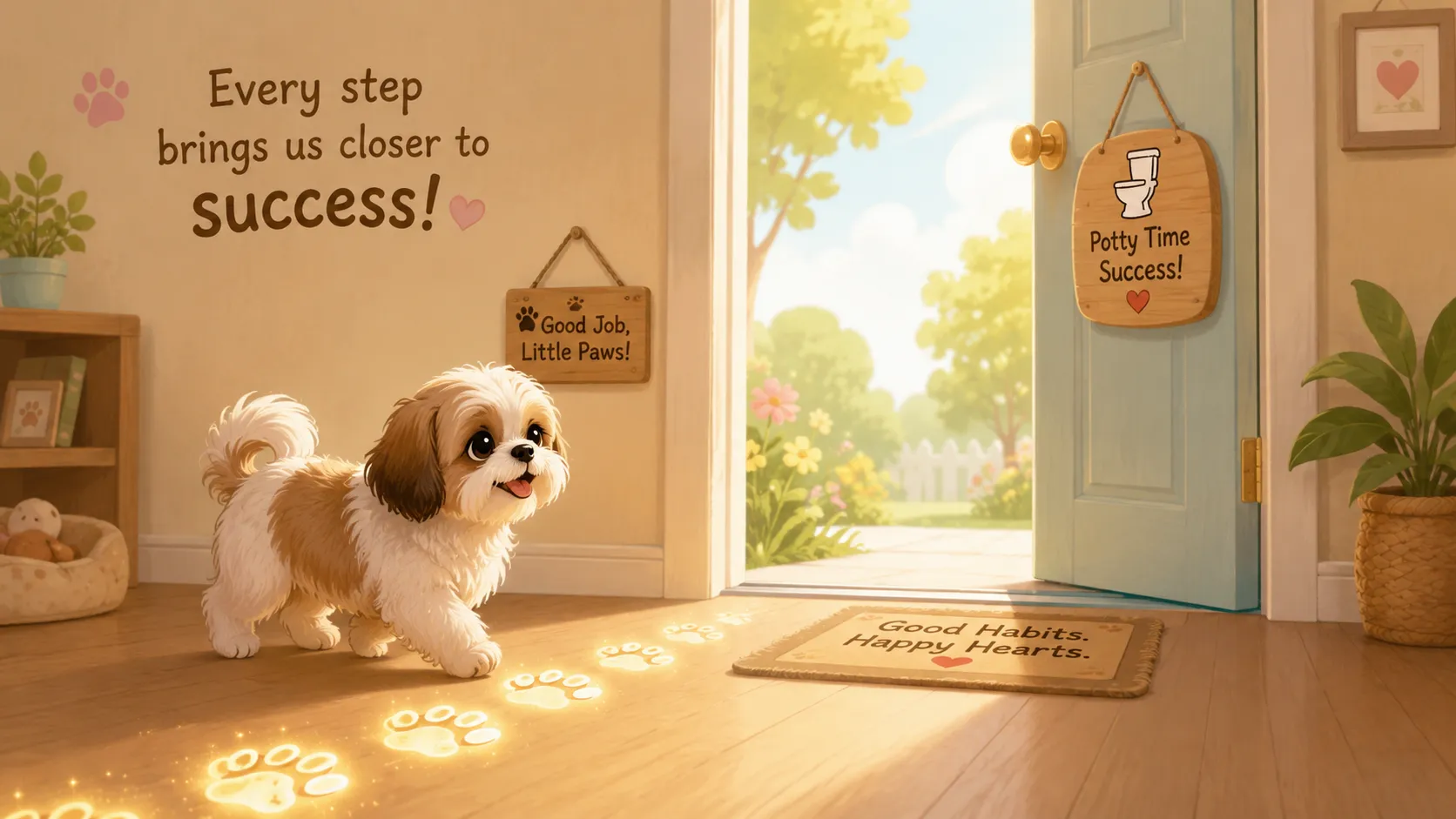
Bringing home a fluffy little Shih Tzu feels a bit like welcoming a tiny royal into your house. They are affectionate, charming, playful, and incredibly lovable. Then reality hits. Your adorable puppy suddenly pees on the carpet five minutes after being outside, poops behind the couch, and stares at you as if nothing happened. If you are wondering whether Shih Tzus are naturally stubborn with house training, the answer is yes; many owners experience exactly the same challenge.
The good news is that toilet training a Shih Tzu is absolutely possible with the right strategy. The process simply requires patience, structure, and consistency. Unlike some larger breeds that quickly understand routines, Shih Tzus often test boundaries and get distracted easily. Their tiny bladders also mean accidents happen more frequently, especially during puppyhood. According to veterinary and training guidance from trusted pet experts, successful potty training depends heavily on repetition, positive reinforcement, and maintaining a predictable schedule.
Think of house training like teaching a child how to follow a daily routine. If the rules constantly change, confusion appears fast. Your Shih Tzu does not understand what “bad” means in a human sense. They learn through habits, timing, rewards, and repetition. Once those patterns become clear, progress starts to accelerate. Many owners give up too early because they mistake slow progress for failure, when in reality the dog is still learning.
This guide will walk you through everything you need to know, from understanding why Shih Tzus struggle with house training to using crates correctly, preventing repeat accidents, recognizing potty signals, and building long-term habits that stick for life.
Why Shih Tzus Are Often Difficult to House Train
The Personality Traits Behind Their Stubbornness
Shih Tzus are intelligent dogs, but they are also famously independent. That combination can create frustration during toilet training because intelligence does not always equal obedience. These dogs were originally bred as companion animals for Chinese royalty, not as working dogs trained to follow commands all day. As a result, many Shih Tzus have a “what’s in it for me?” attitude when learning routines.
A Shih Tzu puppy often becomes distracted by everything around them. One moment they are sniffing the grass to potty, and the next moment they are chasing a leaf across the yard. This short attention span makes consistency incredibly important. If owners are inconsistent with timing or supervision, the puppy quickly develops bad habits. Many people accidentally reinforce indoor accidents by allowing too much freedom too early.
Another issue is emotional sensitivity. Shih Tzus respond poorly to harsh corrections. Yelling or punishment may cause fear, anxiety, or secretive bathroom behavior. Instead of learning where to go, the dog learns to hide when eliminating. That is why positive reinforcement consistently works better than punishment. Veterinary experts emphasize that rewarding desired behavior immediately helps puppies associate outdoor elimination with positive outcomes.
Shih Tzus also thrive on comfort. If the weather outside is rainy, windy, cold, or noisy, many of them would rather stay indoors. This breed can become surprisingly dramatic about wet grass or uncomfortable temperatures. Owners sometimes mistake this behavior for defiance, but it often comes down to environmental discomfort and hesitation.
Small Bladders and Frequent Bathroom Needs
One of the biggest reasons toilet training takes longer with Shih Tzus is simple biology. These are small dogs with very small bladders. Young puppies physically cannot hold urine for long periods. Expecting a 10-week-old Shih Tzu to wait several hours is like expecting a toddler to sit through a movie without needing the bathroom.
Veterinary guidance recommends frequent potty trips for young puppies, sometimes every 30 to 60 minutes during the early stages of training. That sounds exhausting because, honestly, it is. But frequent trips dramatically reduce accidents and help the puppy connect the correct location with the act of elimination.
The challenge becomes even greater because Shih Tzus often drink water in bursts. They may ignore their bowl for hours and suddenly gulp a large amount at once. That means potty timing can feel unpredictable unless owners monitor patterns closely. Puppies also need bathroom breaks after meals, naps, excitement, play sessions, and waking up in the morning.
Here is a quick breakdown of common potty triggers:
| Trigger | Why It Matters |
|---|---|
| Waking up | Bladder fills overnight |
| After eating | Digestion stimulates elimination |
| After playtime | Excitement increases urgency |
| After drinking water | Small bladder fills quickly |
| Before bedtime | Prevents nighttime accidents |
Understanding these triggers helps owners anticipate accidents before they happen. That anticipation is the secret weapon of successful toilet training.
Preparing Your Home Before Training Begins
Choosing a Dedicated Potty Area
One mistake many new owners make is constantly changing the potty location. Dogs learn through association, and consistency in location helps speed up learning dramatically. Before training begins, choose a dedicated bathroom area and stick with it.
If you plan to train outdoors, pick one section of the yard and use it repeatedly. The scent left behind actually encourages your puppy to return there again. Dogs naturally prefer eliminating where they smell previous waste. This is one reason repeated accidents happen in the same indoor locations as well.
Indoor potty pad users should also keep the pad in one consistent area. Moving pads around confuses the dog and weakens habit formation. Imagine if someone moved your bathroom every few days; you would probably feel frustrated too.
The potty area should also remain calm and distraction-free. A noisy street, heavy foot traffic, or overly stimulating environment can interrupt the puppy’s focus. Shih Tzus already struggle with concentration, so minimizing distractions matters more than many owners realize.
Essential Supplies for Faster Training
Toilet training becomes easier when you prepare properly from the beginning. Having the right tools removes stress and creates structure. You do not need expensive gadgets, but several items make a huge difference.
Essential training supplies include:
- A properly sized crate
- High-value treats
- Enzymatic cleaner
- Puppy pads if using indoor training
- A leash for controlled potty breaks
- A feeding schedule
- Baby gates or playpens
The enzymatic cleaner is especially important. Ordinary household cleaners often fail to remove urine odors completely. Dogs can still smell residual scent markers even when humans cannot. Those lingering smells encourage repeated accidents in the same location. Experts consistently recommend enzyme-based cleaners because they break down odor-causing compounds more effectively.
Treats should also be small and immediate. Timing matters. Reward your puppy within seconds of successful elimination outdoors. If you wait too long, the puppy may associate the reward with something unrelated, like walking back inside.
Creating a Routine That Encourages Faster Progress
Feeding Schedules and Bathroom Timing
Routine is everything when toilet training a Shih Tzu. Dogs learn patterns faster than language. When feeding and bathroom breaks happen at predictable times, your puppy’s body begins adjusting naturally.
Free-feeding; leaving food available all day; makes bathroom timing unpredictable. Scheduled meals create predictable digestion, which creates predictable potty habits. Most trainers recommend feeding puppies at the same times each day and removing uneaten food after about 15 to 20 minutes.
Consistency also reduces owner stress. Instead of constantly wondering when your puppy might need to go, you start recognizing reliable rhythms. Over time, you almost develop an internal clock for your dog’s bathroom schedule.
According to pet training experts, puppies under eight weeks may require bathroom breaks every one to two hours. As the puppy grows, bladder control gradually improves. Still, Shih Tzus often take longer than larger breeds to develop reliable control.
The Importance of Morning and Bedtime Potty Breaks
Morning potty trips are critical because puppies often wake up with full bladders. Carrying your Shih Tzu directly outside after waking up can prevent accidents before they happen. Do not stop to cuddle, play, or check your phone first. Every second matters.
Bedtime potty breaks are equally important. Think of it like emptying a water balloon before storing it overnight. The more completely your puppy empties their bladder before sleep, the lower the chance of overnight accidents.
Many owners unintentionally sabotage nighttime training by allowing excessive evening water intake without adjusting bathroom breaks accordingly. Water restriction should never be extreme, but monitoring intake before bedtime can help create better overnight success.
Recognizing the Signs Your Puppy Needs to Go
Common Behavioral Clues Owners Miss
Your Shih Tzu actually communicates bathroom needs constantly. The problem is that many owners fail to recognize the signals until it is too late.
Common potty signals include:
- Sniffing the floor intensely
- Circling repeatedly
- Suddenly wandering away
- Whining near doors
- Pacing nervously
- Squatting unexpectedly
- Interrupting playtime
The earlier you notice these signs, the easier it becomes to prevent accidents. Puppies often give only a brief warning before eliminating, especially when excited.
Some dogs also develop subtle “tells.” One Shih Tzu may stare at the door while another scratches the floor. Observing your individual puppy closely helps you identify unique behavior patterns.
Tracking Patterns to Prevent Accidents
Successful owners often think like detectives. Instead of reacting emotionally to accidents, they look for patterns. When did the accident happen? What happened beforehand? How long since the last potty break?
Keeping a simple potty log for the first few weeks can reveal useful trends. You may notice accidents occur consistently after naps or after certain meals. Once patterns become visible, prevention becomes much easier.
Many owners underestimate how quickly habits form. Every successful outdoor potty reinforces good behavior. Every indoor accident reinforces bad behavior. That is why supervision matters so much during early training stages.
Crate Training and Supervision Done Effectively
How Crates Support House Training
Crates work because dogs naturally avoid soiling their sleeping space. Veterinary experts consistently describe crates as valuable tools for housetraining when used correctly.
The key phrase here is “used correctly.” A crate is not punishment. It is a management tool that creates structure and prevents unsupervised accidents. The crate should feel like a safe den, not a prison.
The crate size matters enormously. If the crate is too large, your puppy may use one corner as a bathroom and sleep in another. Experts recommend crates large enough for standing, turning around, and lying comfortably; but not excessively spacious.
Crate training also teaches bladder control gradually. Puppies learn to “hold it” for short periods, which supports long-term house training success.
Avoiding Common Crate Training Mistakes
One of the biggest mistakes owners make is crating puppies for too long. Puppies cannot physically hold urine for extended periods. Excessive confinement often creates accidents and anxiety instead of progress.
Another mistake is using the crate as punishment after accidents. This creates negative emotional associations with the crate and weakens training effectiveness.
Online puppy communities frequently discuss the importance of balancing supervision with crate time. Some owners report major improvement only after closely managing every unsupervised moment. The goal is not constant confinement but preventing repeated rehearsal of indoor accidents.
A helpful strategy is the “umbilical cord method,” where the puppy remains attached to you via leash indoors. This keeps them close enough for immediate supervision while still allowing freedom.
Indoor Pads vs Outdoor Training Approaches
Benefits and Drawbacks of Puppy Pads
Puppy pads can be useful, especially for apartment owners or during harsh weather. They provide convenience and reduce panic during emergencies. Veterinary guidance also notes that pads can help puppies learn elimination concepts while bladder control develops.
Still, pads create potential confusion. Your puppy learns that sometimes indoor elimination is acceptable. Transitioning later to outdoor-only habits may take extra effort.
Pads also require careful placement and consistency. Constantly relocating pads weakens training clarity and slows progress.
When Outdoor Training Works Better
Outdoor training generally creates clearer boundaries. Your puppy learns that all elimination belongs outside, reducing confusion over acceptable indoor surfaces.
That said, outdoor training demands stronger owner commitment. Frequent trips outside, especially during bad weather or late at night, can feel exhausting. Many owners underestimate how intense early potty training becomes.
Here is a comparison of both methods:
| Training Method | Advantages | Challenges |
|---|---|---|
| Indoor Pads | Convenient, apartment-friendly | Can confuse boundaries |
| Outdoor Training | Clearer long-term habits | Requires frequent trips |
| Combination Approach | Flexible for owners | Slower consistency |
The best method often depends on lifestyle, living environment, and long-term goals.
What Causes Repeated Accidents in the Same Spot
The Role of Scent Marking
Dogs experience the world through scent. If your Shih Tzu repeatedly pees in one corner, there is usually a reason. Residual odor signals that the location is an acceptable bathroom area.
Even when carpets appear clean, dogs may still detect microscopic scent traces. That smell acts like a glowing neon sign saying, “Bathroom here.”
This is why ordinary soap or carpet spray often fails. Enzymatic cleaners break down odor compounds at the molecular level, reducing the likelihood of repeat accidents.
Cleaning Methods That Actually Work
Effective cleaning requires more than wiping the surface. Blotting thoroughly, applying enzyme cleaner generously, and allowing proper drying time matter enormously.
Steam cleaning sometimes worsens odor problems because heat can permanently bond urine proteins to carpet fibers. Many owners accidentally make repeat accidents more likely through improper cleaning methods.
Blocking access to frequently soiled areas during retraining can also help break established habits.
Correcting Mistakes Without Creating Fear
Why Punishment Slows Progress
Punishment often backfires during house training. Dogs do not connect delayed punishment with previous behavior. According to veterinary experts, dogs have only a very short window for associating consequences with actions.
If you yell at your puppy minutes after an accident, they usually learn only one thing: humans become scary near urine or feces.
Fear-based training may cause:
- Hiding accidents
- Anxiety
- Reduced trust
- Secretive elimination
- Stress-related setbacks
Shih Tzus are especially emotionally sensitive. Harsh corrections can damage confidence quickly.
Positive Reinforcement That Builds Confidence
Positive reinforcement works because it makes desired behavior rewarding. Praise, treats, affection, and excitement all strengthen outdoor potty success.
Timing is everything. Reward immediately after elimination, not after returning indoors. The closer the reward occurs to the behavior, the stronger the association becomes.
Many successful owners also use verbal cues like “go potty” repeatedly during elimination. Over time, the dog begins associating the phrase with the action itself.
How Consistency Shapes Long-Term Success
Managing Setbacks and Regression
Progress is rarely linear. Even puppies doing well suddenly experience setbacks. Growth stages, environmental changes, excitement, illness, or disrupted schedules can trigger regression.
This does not mean training failed.
Many owners become discouraged after one bad week and abandon routines too early. Online puppy communities frequently discuss how persistence eventually pays off, even with stubborn breeds.
When setbacks happen:
- Return to tighter supervision
- Increase potty frequency
- Reinforce rewards
- Review feeding schedules
- Clean accident spots thoroughly
Regression is simply information. It tells you the puppy still needs guidance.
Building Reliable Bathroom Habits for Life
Long-term success comes from repetition over time. Every consistent day strengthens the habit. Eventually, your Shih Tzu develops reliable expectations and routines almost automatically.
The fascinating thing about dog training is that it often transforms the owner too. You become more observant, patient, structured, and proactive. Your puppy learns trust and communication. Over time, both of you start functioning like a synchronized team.
Experts note that full house training may take several months, especially with smaller breeds. That timeline feels long in the moment, but consistency eventually creates dependable habits that last for years.
Conclusion
Toilet training a Shih Tzu can test your patience, your carpet, and sometimes your sanity. These tiny dogs are lovable, intelligent, and incredibly determined, which means they often learn at their own pace. Their small bladders, independent personalities, and emotional sensitivity make consistent training especially important.
The owners who succeed are usually not the loudest or strictest. They are the most patient and predictable. They create routines, supervise carefully, reward success immediately, and avoid turning accidents into emotional battles. They understand that setbacks are normal and that progress builds gradually through repetition.
Crate training, positive reinforcement, proper cleaning methods, and consistent schedules all work together like pieces of a puzzle. Remove one piece, and the process becomes harder. Keep all the pieces aligned, and eventually your Shih Tzu starts understanding exactly what is expected.
One day, seemingly out of nowhere, you realize your puppy has not had an accident in weeks. That moment feels incredibly rewarding because you earned it together.
FAQs
1. How long does it take to toilet train a Shih Tzu?
Most Shih Tzus require several months of consistent training before becoming fully reliable. Smaller breeds often take longer because of their tiny bladders and stubborn personalities. Some puppies improve within weeks, while others may need six months or more.
2. Are Shih Tzus harder to potty train than other breeds?
Yes, many owners and trainers consider Shih Tzus moderately difficult to house train. Their independent temperament and sensitivity can slow progress compared to eager-to-please working breeds.
3. Should I use puppy pads or train outdoors?
Both methods can work. Puppy pads offer convenience for apartment living, while outdoor training often creates clearer long-term bathroom habits. The best option depends on your living situation and consistency.
4. Why does my Shih Tzu keep peeing in the same spot?
Dogs are strongly influenced by scent. If urine odor remains in the carpet or floor, your puppy may continue returning to that area. Enzymatic cleaners help remove odor more effectively than regular household cleaners.
5. Is crate training cruel for Shih Tzus?
No, when done correctly, crate training is considered a safe and effective management tool. Veterinary experts explain that dogs naturally enjoy den-like spaces when introduced positively.

Corbin Hale is a 29-year-old American content writer based in Boise, Idaho. He has spent several years creating well-researched articles about pets, home living, and practical lifestyle topics while contributing to websites such as pawlogic.online. His writing focuses on accuracy, reader-friendly explanations, and trustworthy information supported by careful research and real-world experience.