
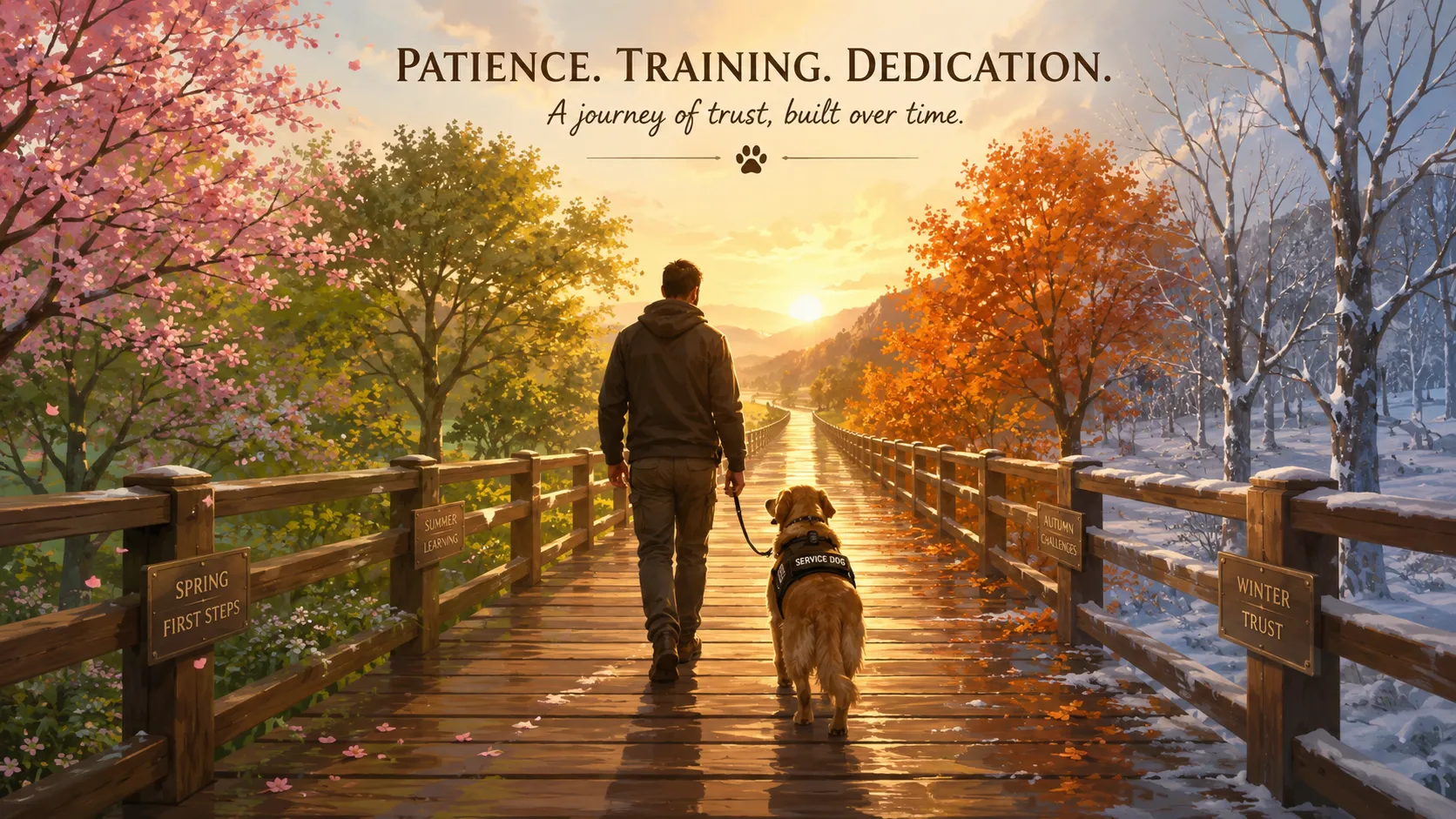
Training a service dog is not a weekend project. It is a long, layered process that transforms a playful puppy or young dog into a calm, focused working partner capable of supporting someone through daily life. Most people see the polished final result; a dog quietly lying under a restaurant table or guiding a handler through a crowded airport; but they rarely see the months and years of repetition behind that behavior.
Recent industry data shows that most service dogs require 18 to 24 months of structured training before they are considered reliable for full-time public work. Some highly specialized dogs, especially medical alert or mobility assistance dogs, may take even longer.
What makes the timeline so long? It is not just about teaching commands. A service dog must learn emotional control, public manners, task accuracy, environmental confidence, and unwavering consistency under pressure. Imagine teaching a child not only how to read but also how to remain calm in every stressful situation imaginable. That is essentially what service dog training involves.
Understanding the Full Timeline of Service Dog Development
Many first-time handlers assume service dog training is mostly obedience work. Sit, stay, heel, retrieve; done. The reality is far more complex. A service dog must perform tasks flawlessly while ignoring distractions that would tempt or overwhelm the average pet dog. That level of reliability takes time because dogs do not naturally generalize behaviors across environments.
A dog that behaves perfectly at home may completely lose focus in a crowded shopping mall. Trainers often say that the hard part is not teaching the behavior; it is teaching the dog to perform the behavior everywhere. That is why service dog training is built in stages. Each phase develops emotional maturity, confidence, and consistency before adding more difficulty.
Industry reports published in 2026 estimate that most owner-trained service dogs need 18 to 24 months before full public access readiness, while program-trained dogs may take two to five years when breeding, puppy raising, and matching processes are included.
Why Service Dog Training Takes Longer Than Pet Training
Pet dogs are generally trained for household manners. Service dogs are trained for life-critical reliability. There is a huge difference between a dog who sits for a treat in the kitchen and one who calmly guides a handler through a chaotic airport terminal filled with noise, moving crowds, and food smells.
Service dogs must remain emotionally steady in unpredictable environments. They cannot bark at strangers, react aggressively toward dogs, panic during loud sounds, or lose concentration during stressful moments. That emotional stability takes months of careful exposure and reinforcement.
Training also includes advanced disability-specific tasks. Medical alert dogs may need hundreds or even thousands of repetitions before reliably identifying scent changes related to blood sugar fluctuations or seizures. According to recent training statistics, many task-specific behaviors require 500 to 1,000 repetitions per command for consistency.
Average Time Required for Different Service Roles
Not all service dog roles require identical timelines. Some tasks are simpler to teach than others. A psychiatric service dog trained for grounding or deep pressure therapy may progress faster than a guide dog navigating traffic safely.
Here is a general comparison of average timelines:
| Service Dog Type | Average Training Time |
|---|---|
| Psychiatric Service Dog | 18–24 months |
| Mobility Assistance Dog | 2 years or more |
| Medical Alert Dog | 2–3 years |
| Guide Dog | 2+ years |
| Hearing Service Dog | 18–24 months |
The complexity of the task directly affects the timeline. Dogs performing scent-based medical alerts often require the longest development because scent discrimination demands extraordinary precision.
The Different Stages of Service Dog Development
Every successful service dog goes through developmental stages that build on each other like bricks in a wall. Skip one layer, and the structure becomes unstable later. Responsible trainers rarely rush the process because shortcuts usually create long-term behavioral problems.
Puppy Socialization Stage
The first stage usually begins between 8 weeks and 6 months of age. During this period, puppies experience what trainers call the “critical socialization window.” This phase shapes how the dog perceives the world for the rest of its life.
A puppy exposed positively to people, sounds, surfaces, traffic, medical equipment, children, and public environments is more likely to become a confident adult. Think of socialization like building a mental library. Each safe experience becomes evidence that the world is manageable rather than frightening.
Early Environmental Exposure
Early exposure should be calm and controlled, not overwhelming. Flooding a puppy with too much stimulation too quickly can backfire badly. A confident service dog candidate learns gradually that elevators, shopping carts, wheelchairs, and loud announcements are normal parts of life.
Professional trainers often introduce puppies to:
- Grocery store parking lots
- Public transportation sounds
- Automatic doors
- Restaurant patios
- Medical environments
- Crowded sidewalks
- Different flooring textures
The goal is not obedience yet. The goal is emotional neutrality.
Basic Obedience Foundation
Between 4 and 9 months, training becomes more structured. Dogs begin learning formal obedience behaviors including heel, stay, recall, settle, and impulse control.
This stage looks simple from the outside, but it is where trainers build communication systems that last for the dog’s entire career. A reliable “leave it” command, for example, may someday stop a dog from eating dangerous food on the floor of a hospital cafeteria.
Building Focus and Impulse Control
Impulse control separates service dogs from ordinary pets. The dog learns that distractions do not automatically deserve attention. Food on the floor? Ignore it. Another dog barking nearby? Stay focused. A child running past? Continue working.
This takes enormous repetition. Trainers intentionally increase distractions little by little so the dog succeeds without becoming overwhelmed. According to trainers interviewed in recent public access discussions, pushing dogs too hard too early can create burnout and long-term stress responses.
Task-Specific Training
Once foundational obedience is reliable, trainers begin teaching disability-specific tasks. This stage often starts around 6 to 12 months and continues well into adulthood.
Examples include:
- Retrieving dropped items
- Deep pressure therapy
- Guiding around obstacles
- Medication reminders
- Interrupting panic behaviors
- Detecting scent changes
- Opening doors
- Providing balance support
This is where the dog truly becomes a working animal rather than simply a well-trained companion.
Advanced Public Access Preparation
Public access work is often the longest stage because dogs must perform tasks consistently across constantly changing environments. Grocery stores, airports, restaurants, hospitals, buses, elevators, and crowded sidewalks all introduce unique distractions.
Recent service dog training reports describe public access generalization as the most time-consuming part of training because each new location essentially requires retraining the same behaviors again under different conditions.
Why Early Socialization Shapes Long-Term Success
Early socialization influences nearly every aspect of future service work. A poorly socialized puppy may develop fear, anxiety, reactivity, or environmental sensitivity that later prevents reliable public access work.
Think of socialization like building the operating system for the dog’s brain. Commands and tasks are just apps installed afterward. If the operating system is unstable, everything else eventually crashes.
The Critical Development Window
The most important socialization period occurs before roughly 16 weeks of age. During this time, puppies absorb environmental experiences rapidly. Positive encounters create confidence, while frightening experiences may leave lasting impressions.
Trainers prioritize exposing puppies safely to:
- Men, women, and children
- Medical devices
- Loud sounds
- Moving crowds
- Different animals
- Transportation systems
- Busy urban environments
Dogs lacking early exposure often struggle later with fear-based behaviors.
Common Socialization Mistakes
Many owners misunderstand socialization completely. Socialization is not about forcing interaction with everyone. It is about teaching calm observation.
One major mistake is overwhelming puppies with chaotic environments too soon. Another is allowing excessive excitement toward strangers or dogs. Service dogs must remain neutral, not overly social.
Recent community discussions among handlers emphasize that gradual exposure produces better long-term emotional stability than marathon training sessions.
Skills That Take the Most Time to Master
Some service dog skills can be taught within weeks. Others may require years of refinement. The hardest behaviors are usually the ones involving emotional control rather than physical actions.
Public Neutrality
Public neutrality means the dog remains calm and focused regardless of surrounding distractions. This sounds simple until you picture a dog ignoring screaming children, food smells, sudden noises, barking dogs, and strangers attempting interaction all at once.
Neutrality is not natural behavior for most dogs. It requires carefully reinforcing calm responses over hundreds of real-world exposures. Trainers often spend months strengthening this single concept.
Medical Alert Reliability
Medical alert work may be the most difficult skill category of all. Scent-based alerts depend on a dog recognizing subtle biological changes consistently under varying conditions.
Dogs trained for diabetic alert or seizure response often require extensive scent imprinting work over long periods. According to recent training statistics, scent detection programs may require 4 to 6 months of specialized conditioning alone.
Even then, reliability must be constantly maintained through ongoing practice.
Breed Temperament and Learning Speed Differences
Not every dog is suited for service work. Temperament matters just as much as intelligence. Some breeds naturally possess traits that make service work easier, while others struggle with the emotional demands.
Fast-Learning Service Dog Breeds
The most common service breeds include:
| Breed | Strengths |
|---|---|
| Labrador Retriever | Stable temperament, trainability |
| Golden Retriever | Friendly, emotionally steady |
| Standard Poodle | Intelligent, low-shedding |
| German Shepherd | Task-driven, highly focused |
| Collie | Responsive and attentive |
These breeds were selected over generations for cooperation, confidence, and adaptability.
Why Some Dogs Wash Out
Even promising dogs sometimes fail service training. Industry estimates suggest only 30% to 50% of candidate puppies eventually graduate into working service dogs.
Common reasons include:
- Anxiety
- Reactivity
- Health problems
- Low motivation
- Fearfulness
- Environmental sensitivity
- Excessive prey drive
Failure is not cruelty or poor training. Responsible trainers prioritize the dog’s welfare and recognize when a dog would be happier outside demanding public work.
Public Access Training and Real-World Exposure
Public access training transforms a technically skilled dog into a truly dependable working partner. This stage introduces the unpredictability of real life.
Training in Busy Environments
A dog may master commands perfectly at home but struggle in crowded public spaces. Trainers gradually expose dogs to:
- Shopping centers
- Airports
- Restaurants
- Public transportation
- Hospitals
- Schools
- Hotels
The goal is confidence without overstimulation.
Recent handler discussions highlight the importance of short, positive sessions early in development. Many experienced trainers recommend limiting young dogs to 10–20 minute sessions initially to avoid mental exhaustion.
Public Access Test Expectations
Many service dog programs use a Public Access Test to evaluate readiness. The test typically includes:
- Ignoring food distractions
- Remaining calm around strangers
- Quietly settling in restaurants
- Controlled walking through crowds
- Safe elevator behavior
- Reliable task performance
Recent reports estimate most dogs require 12–18 months of consistent public access conditioning before reaching this level reliably.
Common Setbacks During the Training Process
Progress during service dog training is rarely linear. Dogs experience developmental phases, emotional changes, and temporary regressions.
Fear Periods and Regression
Adolescent dogs often experience fear periods where previously comfortable situations suddenly become stressful. A confident puppy may suddenly react nervously toward loud noises or unfamiliar people.
These phases are normal but require careful management. Punishing fear responses can worsen anxiety permanently.
Burnout and Overtraining
Dogs can mentally burn out when pushed too hard too quickly. Overtraining often creates stress, avoidance behaviors, or reduced enthusiasm for work.
Many experienced handlers emphasize ending sessions while the dog is still motivated and successful. Long, exhausting outings may look productive but can actually damage long-term confidence.
How Consistency Influences Overall Progress
Consistency is one of the biggest predictors of training success. Dogs learn through repetition and predictable consequences. Inconsistent rules create confusion and slow progress dramatically.
Imagine learning a language where grammar rules changed every day. That is what inconsistent handling feels like for dogs.
Successful service dog teams usually maintain:
- Daily short training sessions
- Clear behavioral expectations
- Consistent reward systems
- Structured public exposure
- Ongoing maintenance practice
Even fully trained dogs require lifelong reinforcement to maintain reliability.
Signs a Dog Is Truly Ready for Service Work
A dog is not ready for service work simply because it knows commands. Readiness involves emotional stability, consistency, and environmental confidence.
Signs of readiness include:
| Sign | What It Means |
|---|---|
| Calm in crowds | Emotional maturity |
| Reliable focus | Strong handler engagement |
| Neutral toward dogs | Stable temperament |
| Quiet settling | Public manners |
| Consistent task performance | Functional reliability |
| Recovery after stress | Emotional resilience |
A truly ready service dog appears almost effortless in public. The dog works calmly without constant correction or visible stress.
Conclusion
Training a service dog is one of the most demanding forms of canine education. It combines obedience, emotional regulation, environmental resilience, public manners, and disability-specific tasks into a process that often lasts two years or more.
The journey requires patience, structure, and realistic expectations. Early socialization builds confidence. Consistent repetition develops reliability. Gradual exposure strengthens emotional stability. Public access work transforms learned behaviors into dependable real-world performance.
The finished result is far more than a trained dog. It becomes a carefully developed partnership built on trust, communication, and thousands of hours of shared experience.
FAQs
1. How long does it usually take to fully train a service dog?
Most service dogs require 18 to 24 months of consistent training before they are fully prepared for public access work. Some specialized dogs may take longer.
2. What is the hardest part of service dog training?
Public access reliability is often the hardest stage because dogs must perform flawlessly in constantly changing environments with heavy distractions.
3. Can any breed become a service dog?
Technically yes, but certain breeds are naturally better suited due to temperament, confidence, and trainability. Labrador Retrievers and Golden Retrievers remain the most common choices.
4. Why do some service dogs fail training?
Dogs may fail due to anxiety, fearfulness, reactivity, health problems, or difficulty handling public stress. Not every dog enjoys the demands of service work.
5. Do service dogs continue training after graduation?
Absolutely. Service dogs require ongoing practice and reinforcement throughout their working lives to maintain skills and reliability.

Corbin Hale is a 29-year-old American content writer based in Boise, Idaho. He has spent several years creating well-researched articles about pets, home living, and practical lifestyle topics while contributing to websites such as pawlogic.online. His writing focuses on accuracy, reader-friendly explanations, and trustworthy information supported by careful research and real-world experience.