
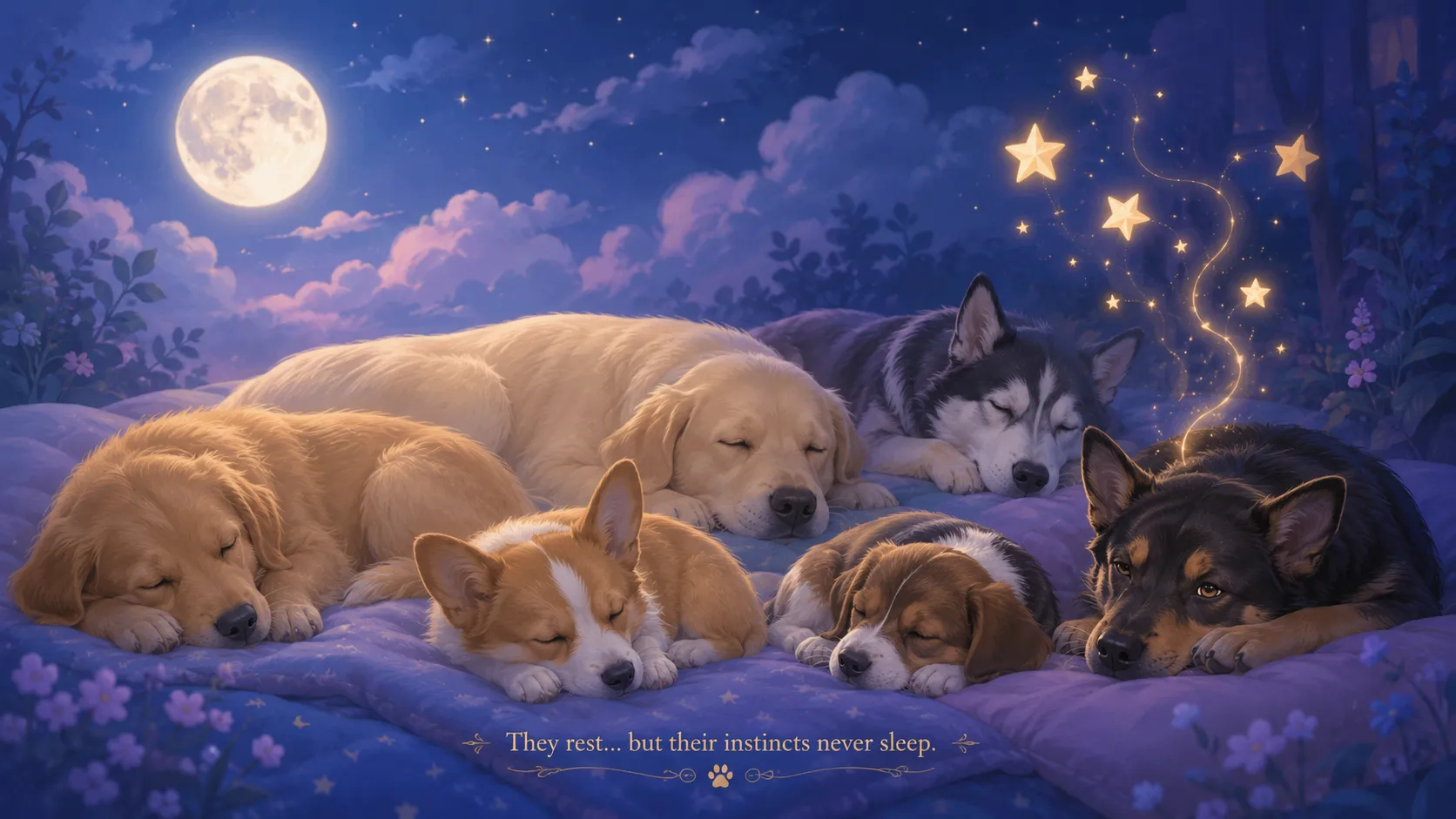
Dogs do plenty of things that leave owners scratching their heads. One of the strangest? Watching your dog appear fast asleep while their eyes stay partially open. It can look spooky, almost like your pup is staring through you from another dimension. Yet for many dogs, this behavior is surprisingly normal.
Some breeds are more likely to sleep with their eyes open because of facial structure, eye shape, sleep cycles, or instinctive behavior passed down from their ancestors. In many cases, it’s harmless. In others, it can signal eye irritation, nerve problems, or neurological conditions that deserve attention. Understanding the difference matters because what looks creepy might actually be completely healthy canine sleep behavior.
Veterinary sources including and explain that partially open eyes during sleep are often connected to REM sleep, light sleep stages, or anatomical traits common in flat-faced breeds. Some dogs even show their third eyelid while sleeping, making the situation look more dramatic than it really is.
Before assuming something is wrong, it helps to understand how dogs actually sleep, which breeds commonly display this habit, and what warning signs should never be ignored.
Why Dogs Sometimes Sleep Without Fully Closing Their Eyes
If you’ve ever tiptoed past your dog at night and noticed their eyes half open, you probably felt a brief moment of panic. Are they awake? Dreaming? Possessed? The truth is far less dramatic. Dogs experience sleep differently than humans, and their partially open eyes often reflect the way their brains move between light and deep sleep stages.
Veterinarians explain that dogs frequently drift into light sleep before entering full REM sleep. During this lighter phase, the muscles around the eyelids may not completely relax yet. The dog appears asleep, but their body remains semi-alert to sounds, movement, or environmental changes. This behavior comes from survival instincts inherited from wild ancestors who needed to stay aware of predators even while resting.
Think of it like a security system running in low-power mode. Your dog’s brain wants rest, but another part still monitors the environment. That’s why many dogs can instantly wake up the second you open a snack bag from across the house. Their sleep may look deep, but their senses are never fully off-duty.
Dogs also spend shorter periods in REM sleep compared to humans. During REM, rapid eye movement occurs beneath partially open lids, causing twitching, tiny paw movements, and soft barking sounds. According to veterinary sleep research, puppies and smaller breeds tend to enter dream sleep more frequently than large dogs.
For many owners, the unsettling appearance is worse than the reality. A dog sleeping with partially open eyes is often just a dog enjoying normal, healthy rest.
The Evolutionary Survival Instinct Behind Light Sleep
Long before dogs became couch-loving companions, their ancestors survived by staying alert in dangerous environments. Wolves and early wild canines couldn’t afford to completely disconnect from their surroundings. Sleeping too deeply could mean becoming prey or missing threats nearby.
That instinct still lingers in domestic dogs today. Even the pampered Chihuahua wearing a tiny sweater carries behavioral traits rooted in survival. Some dogs naturally maintain partial awareness during rest, which can prevent full eye closure during light sleep phases. Veterinary experts believe this instinctive vigilance explains why many dogs seem ready to spring awake at any moment.
Interestingly, some animals take this behavior even further. Dolphins can rest one half of their brain while the other half remains alert. Certain birds sleep while flying. Dogs obviously do not sleep-walk through the neighborhood hunting squirrels, but they still preserve a mild version of environmental awareness during rest.
This survival carryover is especially common in highly alert breeds. Terriers, watchdog breeds, and naturally anxious dogs may appear to sleep lightly because their brains are constantly scanning for unusual noises or movement. Owners sometimes mistake this for stress or poor sleep quality when it is simply part of the dog’s temperament.
Environmental factors can amplify the behavior too. Dogs sleeping in unfamiliar homes, noisy areas, or stressful conditions may keep their eyes partially open more often because their nervous system remains on guard. Rescue dogs especially may display this habit during adjustment periods.
How Canine Sleep Differs From Human Sleep
Humans typically settle into one long overnight sleep cycle. Dogs operate differently. Most dogs sleep in multiple shorter cycles throughout the day and night, often totaling between 12 and 14 hours daily depending on breed, age, and activity level.
Because dogs transition rapidly between sleep stages, you may catch them during incomplete relaxation phases more often. A dog can appear deeply asleep while still responding to sounds around them. This flexible sleep structure helps explain why some dogs rest with eyes partially open or visibly moving.
Here’s a quick comparison between human and canine sleep behavior:
| Sleep Trait | Humans | Dogs |
|---|---|---|
| Main sleep period | Mostly nighttime | Day and night |
| REM frequency | Longer cycles | Shorter, frequent cycles |
| Total daily sleep | 7–9 hours | 12–14 hours |
| Response to sound | Lower during deep sleep | Often highly responsive |
| Twitching during dreams | Mild | Very common |
This fragmented sleep style allows dogs to recover energy efficiently while remaining adaptable to their environment. It’s also why dogs can nap repeatedly throughout the day without seeming lazy. Their biology is designed for bursts of activity mixed with regular periods of rest.
Owners sometimes assume a sleeping dog with open eyes is not resting properly, but that is not always true. Many dogs enter restorative sleep despite their eyes appearing partially open. The key is observing the dog’s overall behavior, energy levels, and health outside sleeping hours.
Dog Breeds More Commonly Associated With Sleeping Eyes Open
Not all dogs sleep with their eyes open equally. Some breeds are far more likely to display this odd habit because of physical anatomy, facial shape, or behavioral tendencies.
Flat-faced breeds, also called brachycephalic breeds, are especially known for this behavior. Dogs like Pugs, Bulldogs, Boston Terriers, and Shih Tzus have shallow eye sockets and prominent eyes, making it harder for their eyelids to fully close during rest. Veterinary experts frequently point to these breeds when discussing incomplete eyelid closure during sleep.
Here are some breeds commonly associated with partially open-eye sleeping:
| Breed | Why It Happens More Often |
|---|---|
| Pug | Bulging eyes and short muzzle |
| Boston Terrier | Shallow eye sockets |
| Bulldog | Loose facial structure |
| Shih Tzu | Large exposed eyes |
| Chihuahua | Hyper-alert personality |
| Cavalier King Charles Spaniel | Sensitive sleep cycles |
| French Bulldog | Facial compression |
| Pekingese | Prominent eye positioning |
Some smaller companion breeds also enter REM sleep quickly and may twitch or move visibly while sleeping. Owners of Chihuahuas and Cavaliers frequently report dramatic dream behaviors that include half-open eyes and rapid eye movement.
Senior dogs may also sleep with eyes open more often due to weakening facial muscles or age-related neurological changes. Puppies, meanwhile, spend more time in REM sleep because their developing brains process enormous amounts of new information daily.
Flat-Faced Breeds and Eye Exposure
Flat-faced dogs are practically designed for this phenomenon. Their shortened skulls compress facial structures, pushing the eyes outward and reducing the ability of the eyelids to fully cover the eyeball.
Pugs and Boston Terriers
Pugs and Boston Terriers are probably the poster children for sleeping with partially open eyes. Their large, round eyes naturally protrude more than other breeds. Because the eyelids stretch over a more exposed eye surface, complete closure during deep relaxation doesn’t always happen.
Owners often notice these dogs appearing awake while snoring loudly on the couch. It can look eerie, but in many cases it’s simply anatomy at work.
Bulldogs and Shih Tzus
Bulldogs and Shih Tzus experience similar structural challenges. Loose facial skin combined with shallow eye sockets creates incomplete lid closure, especially during relaxed sleep states. Some even display the third eyelid, also known as the nictitating membrane, which adds to the strange appearance.
Veterinarians caution owners of these breeds to monitor eye dryness and irritation carefully because incomplete closure can occasionally lead to corneal problems over time.
Understanding Light Sleep vs Deep Sleep in Dogs
A sleeping dog isn’t always equally asleep. Like humans, dogs cycle through different sleep stages, including light sleep, deep sleep, and REM sleep. The position of the eyes often changes depending on which phase the dog is experiencing.
Light sleep is where partially open eyes appear most often. During this stage, dogs remain highly responsive to environmental cues. A nearby sound, movement, or even a familiar scent can wake them quickly. Their muscles relax, but not completely. The eyelids may droop instead of fully sealing shut.
Deep sleep and REM sleep create more dramatic body behaviors. This is when dogs twitch, paddle their legs, softly bark, or rapidly move their eyes beneath partially open lids. Veterinary sources explain that REM sleep is strongly associated with dreaming activity in dogs.
Many owners mistakenly assume twitching indicates a seizure, but there are important differences. REM movements are generally rhythmic, mild, and easy to interrupt. Seizures tend to involve stiff limbs, loss of awareness after waking, confusion, drooling, or inability to respond.
Watching your dog’s body language matters more than focusing solely on the eyes. A calm, relaxed dog who wakes normally is usually fine.
REM Sleep and Eye Movement
Rapid Eye Movement sleep is where things get weird. During REM, the brain becomes highly active even though the body remains mostly relaxed. This stage is associated with dreaming in both humans and dogs.
Dogs often display eye movement beneath partially open eyelids during REM. Owners may notice darting pupils, whisker twitching, tail flicks, or soft vocalizations. Smaller breeds and puppies tend to experience REM sleep more frequently, which means they often show these behaviors more dramatically.
Imagine your dog mentally replaying the greatest moments of their day. Chasing squirrels. Guarding the backyard. Demanding treats. Their sleeping body may react to those dream scenarios in tiny physical bursts.
This phase can look unsettling if you’ve never seen it before, especially when combined with half-open eyes. Yet it is often a sign of healthy neurological activity rather than a problem.
Twitching, Barking, and Dreaming Behaviors
Dogs rarely sleep silently and motionlessly for long periods. Twitching during sleep is extremely common and often accompanies partially open eyes.
Some behaviors owners regularly observe include:
- Paw paddling
- Tail wagging
- Soft barking
- Nose twitching
- Whining
- Rapid eye movement
- Small body jerks
These actions typically happen during REM sleep and usually stop once the dog wakes up. Reddit discussions and veterinary forums are filled with owners describing their dogs “running” in their sleep while staring blankly into space.
The important thing is context. A dreaming dog generally wakes easily and behaves normally afterward. A dog experiencing neurological distress may remain disoriented, struggle standing, or appear confused after the episode ends.
Facial Structure and Eye Shape Factors Explained
A dog’s face shape plays a massive role in whether they sleep with eyes open. Certain breeds physically struggle to fully close their eyelids because of skull structure and eye placement.
Brachycephalic breeds have shortened snouts that compress the skull from front to back. This pushes the eyes outward, increasing exposure and reducing protective coverage from the eyelids. Even while awake, some of these dogs never fully blink in the same way longer-snouted breeds do.
This can create a condition called lagophthalmos, where the eyelids fail to close completely. Mild forms are common in flat-faced breeds and may only become noticeable during sleep.
The third eyelid also contributes to confusion. Dogs possess a translucent protective membrane near the inner corner of the eye called the nictitating membrane. During sleep, this membrane may slide partially across the eye, creating a ghostly white or pink appearance that alarms many owners.
In reality, the third eyelid helps protect and lubricate the eye surface. Seeing it briefly during sleep is often completely normal.
Bulging Eyes and Incomplete Lid Closure
Prominent-eyed breeds face unique sleep challenges because their eyes protrude farther outward than average. The eyelids must stretch farther to achieve complete closure, which becomes difficult during deep relaxation.
Dogs with especially exposed eyes are also more vulnerable to:
- Dry eye
- Corneal ulcers
- Irritation
- Excessive tearing
- Eye infections
Owners should regularly check for redness, discharge, squinting, or cloudy appearance. Sleeping with partially open eyes alone is not necessarily dangerous, but chronic dryness can create complications over time.
The Role of the Third Eyelid
The third eyelid deserves its own explanation because many owners mistake it for disease. This hidden membrane acts like a built-in windshield wiper for canine eyes. It protects against debris and helps maintain moisture.
During sleep, especially REM sleep, the membrane may become visible if the outer eyelids relax partially open. According to veterinary experts, this appearance is usually harmless unless accompanied by swelling, redness, or persistent protrusion while awake.
The first time owners see it, they often panic because it looks unnatural. Yet in many cases, it is simply part of normal canine anatomy doing its job.
When Sleeping With Open Eyes Is Completely Normal
Most of the time, a dog sleeping with partially open eyes is not a medical emergency. Healthy dogs commonly display this behavior occasionally or even regularly throughout life.
It is generally considered normal when:
- The dog wakes easily
- The eyes are not red or inflamed
- No discharge is present
- The dog behaves normally afterward
- Twitching stops after waking
- The behavior happens mainly during dreaming
Veterinary experts consistently note that relaxed REM sleep behaviors are harmless in the majority of dogs.
Owners often make the mistake of comparing canine sleep directly to human sleep. Dogs simply do not sleep exactly like we do. Their cycles are shorter, lighter, and more reactive to environmental stimulation.
Sometimes the weirdest-looking canine habits are actually signs of comfort. A dog sprawled upside down with twitching paws and half-open eyes may simply feel safe enough to enter deep dream sleep around you.
Situations That Usually Require No Concern
A sleeping dog with open eyes usually isn’t a problem if the behavior is occasional and unaccompanied by symptoms. Puppies, elderly dogs, and flat-faced breeds commonly display this pattern naturally.
Changes in sleeping position can also affect eyelid closure. Dogs resting on their backs or sides may experience more relaxed facial muscles, causing the eyes to drift slightly open.
Environmental stimulation matters too. Dogs sleeping in busy households may remain in lighter sleep states longer because sounds constantly activate alertness mechanisms.
Common Behaviors Owners Misinterpret
Many owners confuse normal sleep behaviors with emergencies. Commonly misunderstood actions include:
- Twitching paws mistaken for seizures
- Half-open eyes mistaken for consciousness
- Whimpering interpreted as pain
- Visible third eyelid mistaken for injury
- Sudden waking interpreted as anxiety
Understanding normal canine sleep patterns reduces unnecessary panic while still helping owners recognize genuine warning signs.
Warning Signs That Could Point to Health Problems
Although partially open eyes during sleep are often harmless, there are situations where veterinary attention becomes important.
Seek medical evaluation if your dog shows:
- Persistent red eyes
- Thick discharge
- Swelling
- Difficulty closing eyes even while awake
- Confusion after sleep
- Sudden collapse
- Repeated abnormal episodes
- Loss of coordination
- Sleeping at inappropriate times
Conditions like facial nerve paralysis, seizures, narcolepsy, dry eye syndrome, and neurological disorders can occasionally contribute to abnormal sleep behaviors.
A useful rule of thumb is simple: if the dog acts normal after waking, it is usually less concerning. If behavior changes dramatically, professional evaluation is wise.
Eye Disorders and Nerve Issues
Facial nerve damage can interfere with eyelid control, preventing normal closure during sleep or wakefulness. Eye injuries, inflammation, or chronic irritation may also make blinking uncomfortable.
Flat-faced breeds face elevated risk because exposed eyes dry more easily. Owners should watch for:
- Excessive blinking
- Pawing at eyes
- Cloudiness
- Sensitivity to light
- Chronic tearing
Veterinary ophthalmologists can diagnose underlying structural or neurological causes if symptoms persist.
Seizures vs Normal REM Sleep
Distinguishing dreams from seizures matters. Dreaming dogs generally:
- Wake easily
- Respond to voice
- Resume normal behavior quickly
Seizing dogs may:
- Become rigid
- Paddle violently
- Drool excessively
- Lose bladder control
- Remain confused afterward
If uncertain, recording a video for your veterinarian can be extremely helpful.
Helping Your Dog Sleep More Comfortably
Good sleep hygiene isn’t just for humans. Dogs also benefit from comfortable, low-stress sleep environments.
Helpful strategies include:
- Providing supportive bedding
- Maintaining a quiet sleep area
- Keeping room temperature comfortable
- Reducing nighttime disruptions
- Monitoring eye health in flat-faced breeds
Dogs prone to dry eyes may benefit from veterinarian-approved lubricating eye products. Some brachycephalic breeds require regular eye cleaning to reduce irritation.
Exercise and mental stimulation also improve sleep quality. A bored dog may nap excessively without achieving truly restful sleep.
Improving Sleep Environment
Dogs sleep best when they feel safe and secure. Consistent routines, predictable environments, and comfortable bedding reduce hypervigilance during rest.
Rescue dogs or anxious dogs may initially sleep lightly with partially open eyes because they remain mentally alert to surroundings. As trust develops, many eventually relax more deeply.
When Veterinary Care Is Necessary
Owners should trust their instincts if something feels abnormal. Sudden changes in sleep patterns, persistent eye irritation, or unusual neurological symptoms deserve professional evaluation.
Veterinarians may examine:
- Eye structure
- Tear production
- Neurological reflexes
- Facial nerve function
- Sleep behaviors
Early intervention often prevents minor issues from becoming major health problems.
Conclusion
Dogs sleeping with their eyes open may look strange, but it is often completely normal. Light sleep cycles, REM dreaming, survival instincts, and facial anatomy all contribute to this quirky canine behavior. Flat-faced breeds like Pugs, Bulldogs, Boston Terriers, and Shih Tzus are especially likely to display partially open eyes during rest because of their eye structure and shortened skulls.
Most dogs showing this habit are simply experiencing ordinary sleep behavior. Twitching, rapid eye movement, and visible third eyelids frequently accompany healthy REM sleep. The real key is observing the bigger picture. A relaxed dog who wakes normally and behaves happily afterward is usually just dreaming about chasing squirrels or stealing snacks.
Owners should stay alert for warning signs like redness, discharge, confusion, or inability to close the eyes while awake. Those symptoms can indicate medical issues requiring veterinary care.
At the end of the day, your dog’s strange sleeping habits are just another reminder that canine behavior is wonderfully weird, endlessly fascinating, and sometimes hilariously creepy.
FAQs
1. Is it normal for dogs to sleep with their eyes partially open?
Yes. Many dogs naturally sleep with partially open eyes during light sleep or REM sleep, especially flat-faced breeds and puppies.
2. Which dog breeds most commonly sleep with their eyes open?
Pugs, Boston Terriers, Bulldogs, French Bulldogs, Shih Tzus, and other brachycephalic breeds are commonly associated with this habit due to their facial anatomy.
3. Should I wake my dog if their eyes are open while sleeping?
Usually no. If the dog appears relaxed and healthy, it’s best to let them rest. Constantly interrupting sleep can cause stress.
4. How can I tell if my dog is dreaming or having a seizure?
Dreaming dogs wake easily and behave normally afterward. Seizures often involve stiffness, confusion, drooling, or difficulty recovering after the episode.
5. Can sleeping with open eyes damage my dog’s eyes?
Sometimes. Dogs with incomplete eyelid closure may develop dryness or irritation over time, particularly flat-faced breeds. Persistent redness or discharge should be checked by a veterinarian.

Merrick Nash is a 40-year-old American content creator from Madison, Wisconsin. He has built a reputation for publishing in-depth guides and expert blog articles for pawlogic.online, combining years of digital publishing experience with careful research and an editorial approach that values clarity, credibility, and helpful advice.